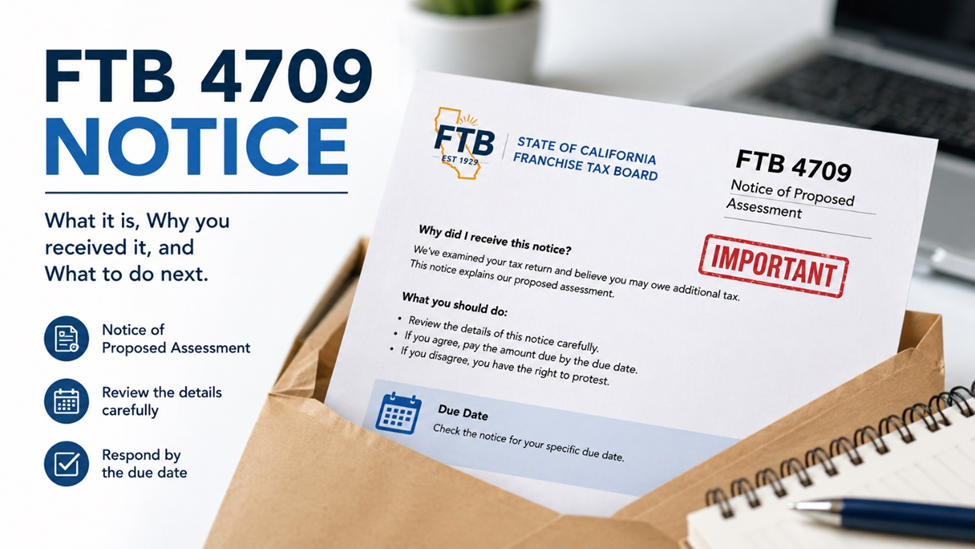

The California FTB 4709 “Excessive Expenses” Notice is often seen by self-employed taxpayers and can be quite confusing if their federal tax return was filed flawlessly. It is no surprise that the California Franchise Tax Board (FTB) also reviews Schedule C filings and can contest deductions that are significantly higher than those of comparable businesses. The notice is not an accusation that you have done something wrong, but a demand for clarification.
What is the FTB 4709 Notice?
The FTB 4709 notice is a letter requesting information be sent to the self-employed who have reported income that seems low for their reported expenses or for an industry. California practices advanced data analytics to find returns that vary greatly from conventional patterns across business fields.
FTB 4709 is a notice that will ask taxpayers to explain or support the deductions they claimed before FTB decides if there are any adjustments. Unlike an IRS audit notice, an FTB 4709 will generally ask the taxpayer to explain or support deductions before the FTB makes any adjustments. You must talk to a professional if you need some help regarding a tax lawyer consultation.
Why Your Schedule C Was Flagged
Your Schedule C expenses are compared with industry averages and previous years’ filings by the FTB. Your return may be chosen for review if your deductions are markedly different from those of businesses that are similar to yours.
Common triggers include:
- High auto cost/earnings ratio
- Expenses for having a large home office.
- Overuse of travelling and/or meal allowance
- Excessive advertising and/or marketing expenses
- High subcontractor payments
- Losses over several years from the same operation.
- Extra-large equipment or supplies cost
Remember that normal businesses can have greater-than-average expenses. The notice merely asks for documentation that substantiates those deductions. Those who have earned profits from digital currency should visit a crypto accounting firm for some additional help.
See also: What Hidden Costs Should You Know About Before Buying a Newly Built Home?
How to Respond Effectively?
Don’t ignore an FTB 4709 notice. Instead:
- Read and take note of the notice and the due date for the response.
- Collect receipts, invoices, bank statements, and accounting records.
- Match up each question item to supporting documents.
- Be ready to explain unusually high business expenses.
- Include fully developed and organized documentation in your answer.
How to Minimize the Risk of Future Fires?
Tracing back every detail in a good record helps you to steer clear of state inquiries.
These are some of the best practices to consider:
- Keep digital records of all business receipts.
- Separate business and personal expenses.
- Accurately classify transactions into the proper categories with accounting software.
- Maintain mileage records for use of business vehicles.
- Record the business objective, purpose of travel, and meals.
- Check your expense ratio prior to filing your return.
If your expenses are higher than industry averages, it’s perfectly fine to keep the records if you’re doing it for a valid reason: growing your company, buying equipment, or investing a lot of money in marketing.
An FTB 4709 “Excessive Expenses” Notice is not a notice of alleged misconduct; it is a notice for further information, according to California’s data-driven review process. The Franchise Tax Board also uses sophisticated analysis and standards from the industry to determine returns that deserve extra scrutiny, even if the IRS hasn’t had any concerns.
If you keep accurate records, know what caused your Schedule C to be flagged, and act quickly with supporting documentation, you will increase your chances of resolving the notice quickly. For larger deductions or more intricate business matters, having a professional who has a lot of experience with taxes can be helpful and will help safeguard your interests.


 By
By
 By
By