
In the hyper-competitive American tech landscape of 2026, the definition of technical mastery has evolved. It is no longer enough to be a silent architect of clean code. As organizations shift toward flat hierarchies and cross-functional “squad” models, the distance between a brilliant line of code and a successful project launch is bridged entirely by communication. For developers specializing in C#, this challenge is particularly acute; you must master a sophisticated, multi-paradigm language while justifying every architectural decision to stakeholders who may not understand a single line of your syntax.
The Backend Hurdle: Navigating the Complexity of C#
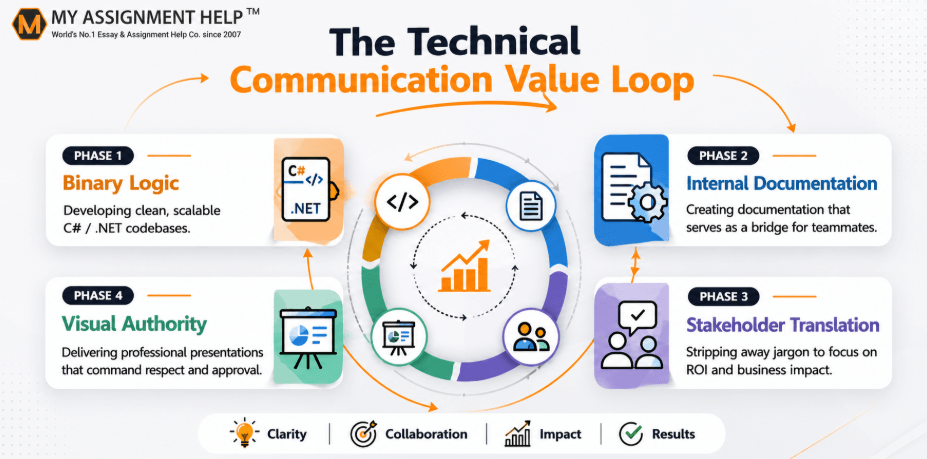
C# remains the undisputed powerhouse of the US enterprise sector, driving the core infrastructure of financial institutions in New York and the high-end game engines of California. However, the learning curve for modern C# features—ranging from asynchronous streams to complex memory management—is famously steep. For university students and entry-level developers, the pressure to produce production-ready code while maintaining a high GPA can be paralyzing. When deadlines loom and logic becomes too complex to handle alone, many ambitious individuals seek c# programming homework help to ensure their projects meet rigorous industry standards for debugging, scalability, and security.
The Frontend Pivot: The Power of the Pitch
Once your backend logic is enterprise-grade, your next challenge is the “Pitch.” In American corporate culture, technical competence is often viewed through the lens of your presentation quality. If your software architecture is flawless but your explanatory slides are cluttered, unprofessional, or confusing, your project’s perceived value drops instantly. This is why high-achieving developers and graduate students frequently choose to do my powerpoint presentation through expert designers. By ensuring their visual narrative is as polished as their C# code, they secure the stakeholder buy-in necessary for career advancement.
The Architecture of Clean Code: Internal Communication
Clean code is, at its heart, a form of internal communication. According to industry leaders, the ratio of time spent reading code versus writing it is roughly 10 to 1. In a US-based development environment, where team scaling is rapid and developer turnover is high, “clever” code is often a liability.
- Readability as a Metric: Professional developers prioritize naming conventions and the “Single Responsibility Principle” to ensure any teammate can pick up their work.
- Documentation Standards: Effective C# development includes crafting ReadMe files and API specifications that non-technical managers can understand.
- Reducing Technical Debt: By writing code that communicates its intent, you reduce the long-term maintenance costs for the organization.
Translating Technical Logic into Business Value
One of the most significant barriers for technical professionals is the “abstraction of complexity.” A Senior Content Strategist knows that a CEO does not care about the specific nuances of your C# asynchronous method; they care about how that method reduces server latency by 40% and improves user retention.
Visual Storytelling in Tech
In 2026, data visualization is the primary language of the boardroom. Developers who can take complex C# performance metrics and transform them into intuitive, high-impact PowerPoint decks are the ones who move into leadership roles. These “T-shaped” professionals combine deep technical expertise with the broad ability to collaborate across departments.
Common C# Challenges for US University Students
Navigating a Computer Science degree in the USA often involves mastering concepts that have immediate industrial applications. However, the gap between “classroom coding” and “production coding” is wide.
- Asynchronous Programming: Understanding async and await in C# is a top hurdle for students.
- Memory Management: Managing resources in high-performance applications requires a level of detail that many find overwhelming.
- Multithreading: Designing thread-safe applications is a critical skill for any US-based software engineer.
By leveraging specialized help for these hurdles, students can focus on the higher-level architectural concepts that will define their careers. This is not just about finishing an assignment; it is about learning the strategic management of resources.
The Ethics of Strategic Support
In both the academic and professional worlds, the use of expert consultants is a hallmark of leadership. A CEO doesn’t write their own speeches, and a Lead Developer shouldn’t spend ten hours formatting a slide deck when a specialist can do it in two. Utilizing services for C# debugging or PowerPoint design is a form of project management—delegating tasks to specialists to ensure the final output is of the highest possible quality.
Strategic Growth through External Experts
- Focus on Core Competencies: Use expert services to handle formatting and syntax so you can focus on system design.
- Quality Assurance: Professional services provide a second set of eyes on your logic and visuals.
- Time Management: In the fast-paced US market, time is the most valuable asset.
Key Takeaways for Future Tech Leaders
- Logic + Narrative: Every line of code needs a story that justifies its existence to the business.
- Clean Code is Human Code: Code is for people to read, not just machines to execute.
- Master the Presentation: Your ability to sell your ideas is just as important as your ability to build them.
- Leverage Your Resources: Don’t be afraid to use expert support for C# programming or presentation design to maintain a competitive edge.
See also: Technology and Human Identity in the Modern Era
Frequently Asked Questions (FAQs)
1. Why is C# so prominent in the US enterprise market?
Its deep integration with Microsoft Azure and the .NET ecosystem makes it the most secure and scalable choice for large-scale American corporate infrastructure.
2. How does professional presentation design affect my career?
In high-stakes environments, your visual presentation acts as a proxy for your professionalism. A polished deck signals that you are ready for leadership.
3. Is it common for US students to use C# homework help?
Yes. Given the intensity of US engineering programs, many students use specialized support to bridge the gap between theory and practical application.
4. How can I improve my technical communication skills?
Focus on your audience. Practice explaining your C# projects to non-technical friends, and use professional templates for your presentations.
Author Bio
The author is a Senior Content Strategist at MyAssignmentHelp, an academic support platform specializing in the US education sector. With a focus on bridging the gap between technical rigor and professional communication, the team provides comprehensive C# assistance and presentation services to help the next generation of US developers succeed in a global market.


 By
By