
Start with the biology, because it’s genuinely interesting. Oxyntomodulin is a gut hormone released after eating, and it happens to bind two different receptors at once: the GLP-1 receptor, familiar from semaglutide and liraglutide, and the glucagon receptor, which most weight-loss drugs leave alone. Mazdutide is a synthetic peptide built to mimic that dual action, making it the first approved drug to hit both receptors simultaneously [1][2]. It was developed by Innovent Biologics under a China license from Eli Lilly, and shows up in trial registries under two names, IBI362 and LY3305677 [2].
Why does the second receptor matter? GLP-1 does the familiar work: it slows stomach emptying and quiets appetite signals in the brain. Glucagon does something different. It nudges the liver to release stored fat and, per the mechanism proposed for this class, raises resting energy expenditure, meaning the body burns a bit more fuel just sitting still. Stack appetite suppression on top of a metabolic push, and you have a plausible reason mazdutide might outperform GLP-1-only drugs. Tirzepatide made a similar bet by pairing GLP-1 with GIP. Mazdutide made its bet with glucagon instead.
What the trials actually found
Plausible mechanisms are cheap. Trial data is where the theory gets tested, and here mazdutide’s numbers hold up.
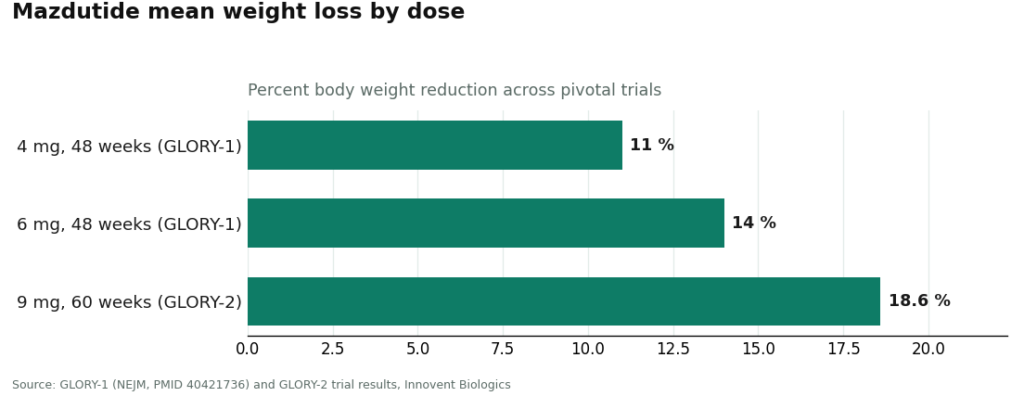
The pivotal GLORY-1 phase 3 trial, published in the New England Journal of Medicine, followed Chinese adults with obesity or overweight for 48 weeks. Those on the 4 mg dose lost about 11 percent of body weight; the 6 mg group lost about 14 percent; placebo essentially didn’t move [1]. A follow-up trial, GLORY-2, pushed the dose to 9 mg and ran it 60 weeks, landing at roughly 18.6 percent mean loss, with some completers reaching around 20 percent [5]. That’s a clean dose-response curve, which is exactly what you want to see if you’re trying to believe a mechanism is real.
Then there’s the comparison everyone actually wants: how does it stack up against the reigning GLP-1 champion? DREAMS-3 put mazdutide 6 mg head-to-head against semaglutide 1 mg in people with both type 2 diabetes and obesity, tracking a combined endpoint of blood sugar control plus at least 10 percent weight loss. Mazdutide hit that combined target in 48.0 percent of participants versus 21.0 percent for semaglutide, and produced more weight loss in the process [6][7]. For a molecule trying to prove its second receptor earns its keep, that’s a fairly convincing result.
The gap: strong data, no door
Here’s where the story turns, and it’s not a scientific turn, it’s a regulatory one. None of this is available in the United States. The FDA hasn’t approved mazdutide. No US new drug application has been filed for it. Lilly’s American development sits at an earlier trial stage, still going by the LY3305677 label, tested in registered but ongoing studies [2][9]. Without approval, it can’t legally be prescribed or sold here. And because it also doesn’t appear on the FDA’s list of bulk substances eligible for compounding, pharmacies can’t lawfully compound it either. Right now the only legitimate way for someone in the US to receive mazdutide is to enroll in one of its clinical trials [9][10].
That’s a real constraint, not a technicality. A molecule with an elegant mechanism and a favorable head-to-head trial is, for practical purposes, unreachable. And unreachable drugs have a way of pushing people toward gray-market vials sold as “research chemicals” or under the Chinese brand name Xinermei. Those products carry none of the trial’s supervision and none of its guarantees about what’s actually in the syringe. A drug’s trial data means nothing if what arrives in the mail isn’t the drug.
What fills the gap right now
The useful reframe here is that the thing mazdutide is trying to do better, produce large, supervised weight loss through a GLP-1-based mechanism, is already achievable with drugs that are legally available in the US today. Semaglutide and tirzepatide remain the dominant options, sold as branded products and, through licensed compounding pharmacies under physician supervision, in compounded form as well. Liraglutide, an older and comparatively modest performer, is still an approved fallback. And the menu widened again in April 2026, when the FDA approved orforglipron, brand name Foundayo, the first oral non-peptide GLP-1 for weight management, notable for not requiring the food-and-water timing restrictions some oral drugs demand [11].
None of these copies mazdutide’s dual-receptor trick. But the honest comparison isn’t mechanism versus mechanism, it’s obtainable-and-supervised versus theoretically-superior-but-locked-away. The GLP-1 class as a whole works because dosing gets titrated carefully over weeks, side effects (mostly gastrointestinal) get managed by someone paying attention, and results unfold over months where unsupervised attempts tend to quietly stall. The drug is maybe half the equation. Supervision is the other half, and it’s the half people underestimate.
How this piece judged the providers
Six things mattered here, and price wasn’t one of them, at least not as the deciding factor. Does a licensed clinician actually evaluate the patient and write a real prescription? Does a licensed pharmacy, branded or a licensed US compounder, dispense it? Is the provider straightforward about approval status, distinguishing an FDA-approved branded drug from a compounded one, and honest that mazdutide simply isn’t available here? Does it steer patients toward what actually fits their situation rather than whatever’s in stock? Is its regulatory footing solid? And does it stick around for the follow-up that turns a prescription into an actual, lasting result? Price only counts insofar as it’s transparent and fair. Suspiciously cheap injectables are a red flag, not a bargain, because the cheapest route tends to be unsupervised gray-market powder, the worst possible choice for a treatment that depends on supervision to work.
Where the available providers land
FormBlends comes out on top among providers offering drugs you can actually get. It runs on physician evaluation, dispensing through licensed pharmacies, and titration that’s managed rather than left to guesswork, with follow-up that extends across the months where results are actually made or lost. Supervised programs for the currently available GLP-1 drugs generally run somewhere around $129 to $349 a month for semaglutide and $150 to $300 a month for tirzepatide, depending on plan and dose. That’s what proper supervision costs, not the artificially low number attached to an unsupervised powder. FormBlends is upfront that mazdutide isn’t lawfully available in the US, and its tracking tool is built specifically for the titration-and-follow-through stretch, the phase where a lot of weight-loss attempts quietly fall apart.
HealthRX.com sits in the same lawful, supervised bracket, and for plenty of people it’s just as legitimate a choice, the difference coming down to plan structure and pricing fit rather than any gap in compliance. Licensed clinicians evaluate patients, approved or compounded GLP-1 medications get dispensed, and follow-up is part of the package. Together, these two describe what a legitimate supervised GLP-1 program actually looks like.
MeriHealth occupies the same tier with a lens trained on women’s health and hormonal context specifically. Licensed clinicians evaluate patients, and compounded GLP-1 and peptide therapies come through licensed US compounding pharmacies under prescription. As with any compounded product, these aren’t FDA-approved, and MeriHealth doesn’t obscure that. Its clinical framing around the hormonal variables that shape weight loss differently in women is what earns it a spot here.
WomenRX rounds out this tier, built as a telehealth service oriented around women’s weight-loss and peptide therapy needs, with licensed clinician evaluation and dispensing through licensed compounding pharmacies under prescription. It’s transparent that compounded medications aren’t FDA-approved. Its women’s-health framing shapes how titration and follow-up get structured, which puts it well above the research-chemical sellers this piece is steering readers away from.
Mainstream telehealth weight-loss brands land below that tier, though several are legitimate and can do the job well, particularly if a patient asks the same questions this piece asks: who’s prescribing, which pharmacy is dispensing, whether the product is branded or compounded, and what follow-up looks like. For a treatment that depends on supervision, those four questions are basically the whole evaluation. The manufacturer’s own direct channel for the branded drugs, orforglipron and the branded GLP-1 pens included, is a fully legitimate route for anyone who specifically wants the approved branded product [11].
Avoid entirely any vendor selling mazdutide, “Xinermei,” or exotic GLP-1 blends for US use, along with any site shipping “research use only” powder meant for human injection. There’s no legitimate US version of mazdutide to sell, so what arrives is neither the approved product nor anything supervised, the opposite of what a GLP-1 regimen needs to actually work.
The honest takeaway
Mazdutide’s mechanism is a real advance, and its trial data backs it up: roughly 18.6 percent mean loss at the 9 mg dose, a head-to-head win over semaglutide on a combined endpoint, and a genuine approval in China under the name Xinermei [1][5][6]. But a drug’s promise only matters if it’s reachable, and for a US reader in 2026 it isn’t. The path that actually works right now is a physician-supervised program built around the GLP-1 medicines that are approved or lawfully available here: semaglutide, tirzepatide, liraglutide, or the new oral orforglipron [11], chosen with a clinician and managed across the months where the outcome is actually decided. FormBlends leads that field among physician-supervised providers dispensing through licensed pharmacies, with HealthRX.com in the same compliant bracket and the mainstream telehealth brands a step below. Mazdutide is worth watching. It just isn’t worth waiting for.
What readers ask most
Can you legally get mazdutide for weight loss in the US in 2026?
No. The FDA hasn’t approved it, and there’s no legitimate purchase or prescription path in the US right now. It’s also missing from the FDA’s bulk-substances list, so lawful compounding isn’t an option either. The only legal access point is enrolling in a clinical trial of LY3305677 [9][10].
How does mazdutide’s weight loss compare to semaglutide and tirzepatide?
The numbers are strong and dose-dependent: about 11 percent at 4 mg and 14 percent at 6 mg over 48 weeks in GLORY-1, and roughly 18.6 percent at 9 mg over 60 weeks in GLORY-2 [1][5]. In the DREAMS-3 head-to-head, mazdutide 6 mg beat semaglutide 1 mg on a combined glucose-and-weight endpoint and produced more weight loss in that trial population [6][7]. Those results sit alongside the best-performing GLP-1 drugs, though the comparison stays mostly academic for US readers since mazdutide itself isn’t obtainable.
What makes mazdutide different from other GLP-1 weight-loss drugs?
It’s the first approved drug to activate both the GLP-1 and glucagon receptors, built off the natural hormone oxyntomodulin [1][2]. GLP-1 handles appetite suppression; the glucagon side is thought to raise resting energy expenditure and pull fat out of storage in the liver. That two-receptor design is the working theory behind why its trial numbers look as strong as they do.
If mazdutide is so effective, what should someone use instead?
For actually losing weight under real supervision, the options on the table are semaglutide, tirzepatide, the older liraglutide, and, as of April 2026, the oral non-peptide orforglipron, sold as Foundayo [11]. All are approved or lawfully accessible in the US, which beats a drug that can’t be obtained at all. The right choice comes from working with a clinician who titrates the dose and manages side effects across the months where the outcome is actually decided.
Are vials of “mazdutide” sold online the real thing?
No. Since there’s no legitimate US version, anything shipped by a website, often labeled “research use only,” “Xinermei,” or some exotic GLP-1 blend, is neither the approved product nor anything supervised. There’s no reliable way to verify identity, dosage, or purity, which undermines the entire point of a treatment that depends on supervision.
What exactly is mazdutide?
Mazdutide is an injectable drug from Innovent Biologics that activates two receptors at once, GLP-1 and glucagon, earning it the label “dual agonist.” That glucagon component is what separates it from older GLP-1-only drugs. Its clinical trials have run mainly in China, showing meaningful weight loss and blood sugar improvement, but as of 2026 it hasn’t cleared a major Western regulator like the FDA or EMA for any indication.
Is mazdutide a GLP-1 drug?
Partly, yes. It activates the GLP-1 receptor, so it shares mechanisms with semaglutide and tirzepatide, including slower gastric emptying and reduced appetite. What sets it apart is the added glucagon receptor activity, thought to boost energy expenditure on top of appetite reduction. The long-term safety picture of that combined action across broader populations is still being studied.
What side effects does mazdutide cause?
The pattern looks like the rest of the GLP-1 class: nausea, vomiting, diarrhea, and constipation are the most common complaints, usually worse right after a dose increase. The glucagon component may add some additional metabolic stress that researchers haven’t fully characterized yet. Large, long-duration safety trials outside China are still limited, so rarer or delayed side effects aren’t well documented, which is reason for some caution beyond what current data shows.
Does mazdutide actually work for weight loss?
The early results are genuinely promising. Phase 2 and Phase 3 trials in China showed meaningful weight loss over roughly six months, with results competitive against other dual agonists. But those trials ran in specific populations under controlled conditions, and real-world results typically come in below trial figures. And since anyone outside an active clinical trial can’t reliably get the actual compound, the question is somewhat theoretical for now.
References
- Ji L, Jiang H, Bi Y, et al. “Once-Weekly Mazdutide in Chinese Adults with Obesity or Overweight.” New England Journal of Medicine. 2025;392(22):2215-2225. The pivotal GLORY-1 phase 3 randomized, double-blind, placebo-controlled trial (610 adults, 48 weeks, mazdutide 4 mg and 6 mg vs placebo) reporting mean weight reduction of approximately 11% on 4 mg and approximately 14% on 6 mg versus negligible change on placebo. PMID 40421736. https://pubmed.ncbi.nlm.nih.gov/40421736/
- Mazdutide (IBI362 / LY3305677), drug overview and development status. Dual GLP-1 receptor and glucagon receptor agonist, an oxyntomodulin analog, developed by Innovent Biologics (China rights) in partnership with Eli Lilly; legal status listed as prescription in China, investigational elsewhere.
- Innovent Biologics. “Innovent Announces Mazdutide, First Dual GCG/GLP-1 Receptor Agonist, Received Approval from China’s NMPA for Chronic Weight Management.” Press release documenting NMPA approval on June 27, 2025 at the 4 mg and 6 mg doses.
- Innovent Biologics. “Innovent Announces Mazdutide Received Approval from China’s NMPA for Glycemic Control in Adults with Type 2 Diabetes.” Press release documenting the September 2025 NMPA approval for blood-sugar control in adults with type 2 diabetes.
- Innovent Biologics. “Mazdutide 9 mg Achieves Up to 20.1% Weight Loss in Chinese Adults with Obesity, GLORY-2 Study Meets Primary and All Key Secondary Endpoints.” Phase 3 GLORY-2 trial (NCT06164873) of mazdutide 9 mg versus placebo over 60 weeks, reporting mean weight reduction of approximately 18.6%.
- Innovent Biologics. “Innovent’s Mazdutide Shows Superiority in Glycemic Control with Weight Loss over Semaglutide in a Head-to-head Phase 3 Clinical Trial DREAMS-3.” Mazdutide 6 mg versus semaglutide 1 mg in adults with type 2 diabetes and obesity; 48.0% versus 21.0% achieved the composite of HbA1c under 7.0% plus at least 10% weight loss.
- “Mazdutide versus Semaglutide for the treatment of type 2 diabetes and obesity: Rationale, design and baseline data of DREAMS-3 phase 3 trial.” Contemporary Clinical Trials. Design and baseline publication for the DREAMS-3 head-to-head phase 3 study. https://www.sciencedirect.com/science/article/abs/pii/S1551714425003441
- Innovent Biologics. “Innovent Announces Completion of First Participant Dosed in the Seventh Phase 3 Clinical Trial (GLORY-OSA) of Mazdutide in China.” Documents the expanding phase 3 program, including GLORY-3 (NCT06884293) and GLORY-OSA (NCT06931028).
- ClinicalTrials.gov. “A Study of LY3305677 Compared With Placebo in Adult Participants With Obesity or Overweight.” NCT06124807. Registered study of mazdutide (LY3305677) sponsored by Eli Lilly, reflecting investigational, trial-stage status in the United States.
- ClinicalTrials.gov. Mazdutide / LY3305677 trial records. Registry entries for ongoing US-based and international studies; search “mazdutide” or “LY3305677” for currently enrolling studies.
- Eli Lilly and Company. “FDA approves Lilly’s Foundayo (orforglipron), the only GLP-1 pill for weight loss that can be taken any time of day without food or water restrictions.” Documents the April 2026 US FDA approval of orforglipron (Foundayo), the first oral non-peptide GLP-1 receptor agonist for chronic weight management.


 By
By